

DISCERNMENT – HOW ELDERS GET THEIR WISDOM
[5-minute read]

[5-minute read]
Imagine you're on a freeway at rush hour, heavy rain pounding the windshield, wipers unable to keep up, horns blaring all around, and you're late for a strategic dinner meeting with your largest client. She brought a potential client of equal stature to this meeting. Both happened to be in town at the same time.
Your "Waze GPS" says "Accident Ahead," stoking the upset even more.
Everyone else is honking, tailgating, weaving frantically between lanes, white-knuckled, screaming inside their own heads. Frustration mounting. Anxiety spiking. Anger is now ruling the asphalt.
Your body reacts - your heart races, your jaw tightens, your neck muscles knot, adrenaline spikes, your shoulders squeeze upward, and a flurry of thoughts swirl around and around.
Your mind cycles through worst-case scenarios: missing the meeting, looking bad for your client, looking bad for the guest, looking incompetent, and on and on. The thought-train steams ahead faster and faster around the circular tracks of catastrophe.
The storm outside mirrors the storm inside, each flash of lightning a drumbeat of urgency, each roar of tires a reminder that the world is chaos and you're right in the middle of it. You feel not at the calm eye of the hurricane, but on the first inner wall where the forces are the most intense.
Every instinct screams fight, speed up, force the cars aside, control the uncontrollable. You grip the wheel hard, your knuckles blanch. You find yourself cursing at the windshield.
Now imagine wisdom at the wheel. Wisdom isn't speeding to beat the traffic. Wisdom isn't honking at the guy two feet ahead who's texting while he’s driving. Wisdom is patient hands on the wheel, eyes scanning the entire road, noticing the patterns others miss, where the potholes are, where brake lights flash first, the rhythm of cars merging. Wisdom knows how to surrender without loss.
Wisdom adjusts speed, chooses lanes with intention, accepts that the storm is real but not personal, and that being late is not a tragedy, it's just part of life.
Wisdom reminds itself that it has the time to make the call in these stop-and-go conditions and speak directly with the client and guest.
While navigating uncertain traffic conditions and upset drivers, wisdom feels rare in rush-hour life: presence, agency, and a consciousness of choice.
Wisdom has interrupted the automatic "stimulus-response" reactions by consciously intervening with a "recognition-choice" response.
Elders practice noticing and labeling their emotional responses, as well as the thoughts and actions these emotions trigger. They can get off the field and into the stands to observe what’s going on with them.
While everyone else burns mental fuel reacting to the turmoil, wisdom moves efficiently, with awareness and patience. There's still urgency, but it's measured and deliberate.
The meeting may still start without this Elder's presence, but the wisdom driver arrives intact, unshaken, and in command of their own mind will step into the room.
Wisdom, in heavy rain on a traffic-jammed freeway, doesn't erase the storm, the slow crawl forward, or people's rudeness—an Elder has a different experience of it.
Others are at the mercy of the storm; Elders are simply with it, moving through it, seeing options, whereas others' anger and upset see no other options.
That's how wisdom transforms life: it doesn't remove the chaos, but it allows you to drive through it with command, serenity, and a sense that you are very much in control of your own lane.

WISDOM DISCERNS
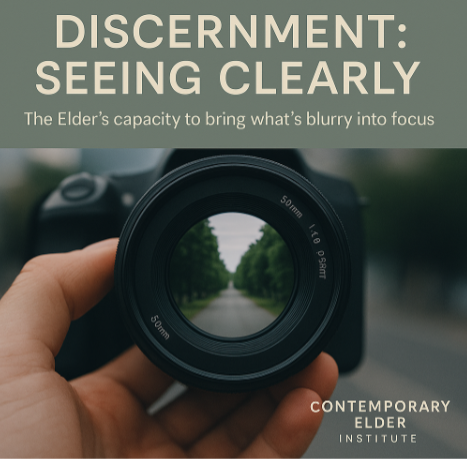
A fundamental element of an Elder's wisdom is the ability to discern. The word "discern" means to perceive, recognize, or understand something clearly and deeply.
Elders' ability to discern turns the subtle and hidden into obvious and uncovered, in oneself and in the world.
Discernment allows them to see beneath the surface, recognize patterns, truths, and consequences that others repeatedly miss, and make choices based on that deeper understanding.
Discernment enables Elders to distinguish between what is essential and what is not.
Discernment promotes moving from the subjective to the objective, allowing you to see the true nature of a situation or, when applied internally, the true nature of yourself.
Discernment doesn't just give answers, but it does profoundly change the way an Elder inhabits the world. It alters their lens through which they see themselves, the people around them, and the invisible currents that shape everything.
Wisdom's discernment grants Elders serenity. Not everything deserves their energy. Not every fire needs to be fought; not every wave needs to be knocked over.
Discernment allows an Elder to be like a conductor leading an orchestra. They don't play every instrument themselves, and they don't force every note.
Instead, Elders know when to bring in the violins to swell the emotion, when to quiet the brass to create space, when to cue the timpani for impact, and when to let silence do the work. Discernment helps Elders direct the right energy to the right section at precisely the right moment of the performance.
Where Elders primarily use discernment is on themselves. Discernment lets you look in your dark corners with a miner’s headlamp.
The gang all agrees.
Socrates: "Know thyself." – One of the most famous aphorisms in Western philosophy, from ancient Greece, emphasizing self-awareness as the foundation of wisdom.
Ralph Waldo Emerson: "What lies behind us and what lies before us are tiny matters compared to what lies within us." – From Self-Reliance, highlights the importance of inner understanding.
Carl Jung: "Your vision will become clear only when you can look into your own heart. Who looks outside, dreams; who looks inside, awakes." – On introspection and self-knowledge as the path to awakening.
Lao Tzu: "Knowing others is intelligence; knowing yourself is true wisdom. Mastering others is strength; mastering yourself is true power." – From Tao Te Ching, connecting self-knowledge to wisdom and inner power.

INTUITION & DISCERNMENT = WISDOM
Intuition is the Elder's radar, a quiet hum beneath the chaos, picking up patterns, intentions, and consequences before the mind has a chance to do its analysis.
Intuition is that feeling in your gut when something is off, a person is dishonest, or the moment isn't right—subtle, almost invisible, but calibrated by years of watching, living, and persisting.
Discernment is the conscious hand that takes intuition's whisper and says, "Here's what matters, here's where to place your energy, here's how to act." Alone, intuition is a spark; alone, discernment is like having a map you don't know how to read.
An Elder's intuition isn't some vague hunch; it's a finely tuned instrument built from decades of living, observing, failing, and reflecting.
Every misstep, heartbreak, victory, and quiet moment of insight has deposited lessons, creating a web of patterns Elders can now clearly recognize.
Elders can feel the currents underneath—the motives, the risks, the unseen consequences. Their intuition is trustworthy because it's been tested in fire, sharpened by reflection, and confirmed by experience. And ignites discernment to get to work.
For deeper exploration of choice-making and discernment:
https://www.ted.com/talks/ruth_chang_how_to_make_hard_choices
Elder as a cultural reality is emerging. And, you're one of those who is making it happen.
That is why you are an Elder. Discernment is a state of consciousness that allows eqanimity and self-awareness.