

What Differentiates Older from Elder is Their “Knowing.”

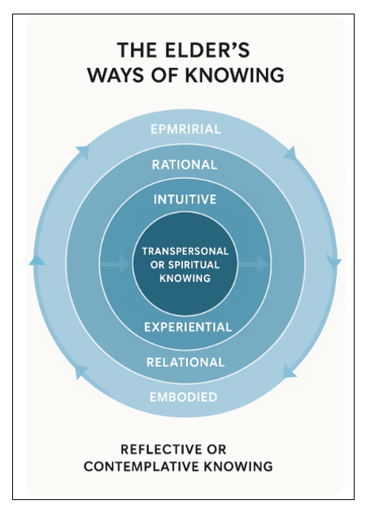
What Differentiates Older from Elder is Their “Knowing.”
Our work—and the work of others in the Elder space—is to help people expand how they know, not just what they know.
Elders know differently from Older. They know themselves differently. They know the world differently. They even know knowing differently.
What you know shapes what you see. What you see shapes how you act. How you act determines what happens next. Elders simply see, think, and feel the world through a different lens. That’s one of the key differences between being Older and being an Elder.

The Kinds of Knowing
• Empirical / Sensory – grounded in what you can observe and touch.
• Rational – the mind’s logic and reasoning.
• Experiential – what life teaches you firsthand.
• Embodied – knowing through the body, gut, and movement.
• Relational – knowing that lives in connection with others and the environment.
• Intuitive – the bridge between the personal and something greater.
• Reflective / Contemplative – the quiet voice inside, the space where insight lands.
• Mythic / Symbolic – understanding life through story, image, and archetype.
• Transpersonal / Spiritual – the knowing beyond the knower, the direct sense of unity with all that is.


Transpersonal / Spiritual
Transpersonal or spiritual knowing in an Elder comes from direct contact with something larger than self. It’s not belief or dogma—it’s the felt sense that you’re part of the whole, not separate from it. Elders no longer see themselves as stand-alone models.
This knowing shows up when the “I” softens, and what’s left is a quiet recognition: life isn’t something happening to you—it’s happening through you. Meaning isn’t out there waiting to be found; it’s already here, woven into everything.
Consciousness is the ground of this kind of knowing. It’s both the observer and the field being observed—the awareness underneath all thought and perception. What I call the center of the moment is that still place before the mind starts explaining, judging, or planning.
You don’t have to take this on faith, just try it. Sit quietly. Breathe. Notice that you’re aware of yourself sitting there, thoughts and feelings moving through. In that simple noticing, you might begin to sense what every Elder eventually discovers: consciousness isn’t something you have—it’s what you are.

Reflective or Contemplative Knowing
This is the bridge from Older and Elder. Elders don’t just think about life; they reflect on it. They look inward and see what’s shaping their view. Reflection turns experience into wisdom.
Contemplation isn’t about thinking harder; it’s about getting quiet enough for truth to rise on its own. It integrates all other forms of knowing. In reflection, you’re not chasing answers—you’re listening for them.
You start to see your patterns, habits, and assumptions without judgment. In that stillness, empathy grows, purpose clarifies, and action lines up with who you really are.
It’s the space between reaction and response—the space where presence lives. That’s where wisdom ripens.

The Mirror of the River
There was once an Elder who walked each morning to the river behind his home. No phone, no notebook—just himself, the current, and whatever questions the day carried.
One morning, a young man asked, “Old one, why do you sit here doing nothing while the world hurries past?”
The Elder smiled. “Do you see the river?”
“Yes,” said the young man.
“When I was your age,” the Elder said, “I came here to learn how the river moved forward—how to get around obstacles, how to keep going. I thought knowing was about getting somewhere. Now, I come to see how the river reflects the sky.”
The young man looked closer. In the still water, clouds drifted in silence.
“When you’re young,” the Elder continued, “you think knowledge is power—something to collect and use. But as you age into Elder, you find that knowing isn’t what you do with your mind. It’s what shows up when your mind gets quiet enough to see what’s already here.”
He tossed a pebble into the water. “What happens?”
“It ripples,” said the young man.
“Exactly. Every thought, judgment, and memory is a stone. When I stop throwing stones, the surface goes still—and life shows me itself.”
The young man frowned. “That just looks like doing nothing.”
The Elder chuckled. “Try it. It’s the hardest work you’ll ever do.”
They sat in silence. The young man squirmed. “I can’t stop thinking.”
The Elder nodded. “Nor could I. For years, I thought I was my thoughts. Then I saw I was the space they passed through—the sky, not the clouds.”
As the sun turned the river to gold, the young man asked, “So what do you know now?”
The Elder looked to the horizon. “That life doesn’t need fixing. It reveals itself when you stop trying to control it. Reflection isn’t escape—it’s alignment. When I live from that place, I act with less noise and more truth. That’s the difference between an old man and an Elder.”
The young man bowed, feeling both humbled and whole.
The Elder smiled. “Go. The river will teach you too. Just stop throwing stones.”

Last Call!
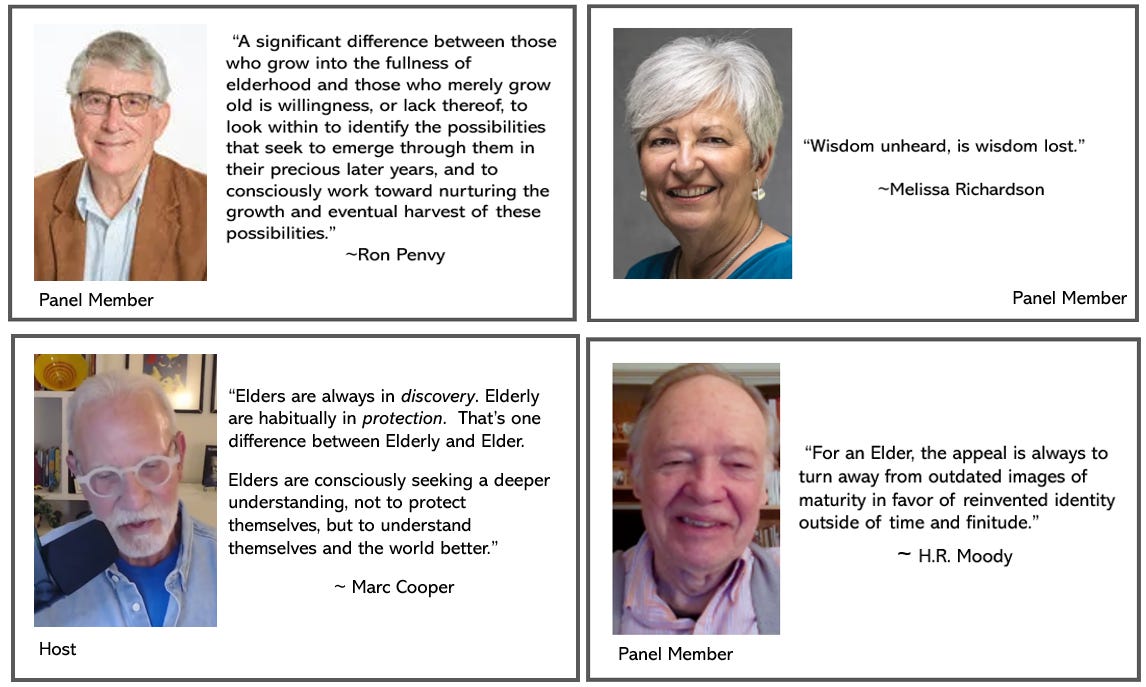
The Elderly or Elder II Webinar: November 3rd: 1pm PT/ 4pm ET
Melinda, we'd love to have you live from Paris, but yes, a recording will be available. Not sure about the next day, since we like to edit for discontinuous blanks when breakout rooms won't be recorded. But I'd say 72 hours till completion. To get your recording, you need to register so that we can have your email address. If you have a group of friends where you talk about growing old together, have them register, get the video, and now you have something new and nurturing to talk about.
Love this Marc. So well articulated. I’d like to attend but it would be 10 pm in Paris. Will a recording be available the next day?