

A ONE-MINUTE ELDER
THE WISDOM DEFICIT

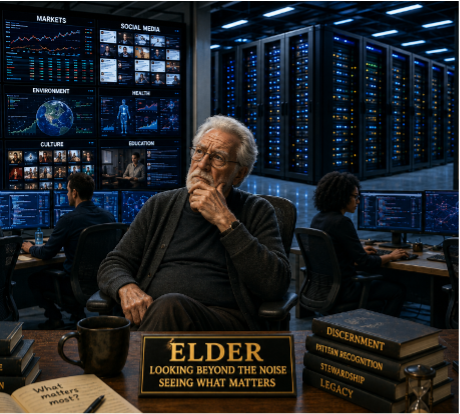
THE WISDOM DEFICIT
Why More Information Is Making Us Less Wise
The world has solved the problem of access to information. Anything you need to know, you can know.
Unfortunately, it may have created a crisis of judgment in the process.
Think about it.
At no time in human history have people had access to more information.
More data.
More experts.
More technology.
More podcasts.
More videos.
More newsletters.
More opinions.
More people absolutely certain they know what they’re talking about.
And yet…
We also have more polarization.
More anxiety.
More confusion.
More outrage.
More short-term thinking.
More people yelling at one another from opposite sides of digital fences.
Something isn’t adding up.
The assumption has always been that if people simply had more information, better decisions would naturally follow.
Come on, now. How’s that working out?
The problem is that we’ve confused information with wisdom.
They are not the same thing.
Not even close.
Knowledge tells us what can be done.
Wisdom tells us what should be done.
Knowledge gave us social media.
Wisdom would have asked what social media might do to attention, relationships, children, and democracy before releasing it into the wild.
Knowledge gave us artificial intelligence.
Wisdom asks what kind of human beings we need to become as we create machines that can outthink us in every domain.
Knowledge creates power.
Wisdom governs power.
Knowledge accelerates.
Wisdom steers.
Knowledge asks, “Can we?”
Wisdom asks, “Should we?”
And right now, humanity appears to be developing knowledge much faster than it is developing wisdom.
That’s not a small problem.
That’s a civilization-level problem.
Most of our institutions are designed to reward speed.
Wisdom moves slower.
Business rewards growth.
Wisdom asks, “Growth toward what?”
Politics rewards certainty.
Wisdom is comfortable saying, “I don’t know.”
Social media rewards reaction.
Wisdom pauses.
Sometimes wisdom waits.
Which is probably why wisdom would never survive as an influencer.
Imagine the post:
“Before reacting, consider multiple perspectives, reflect on long-term consequences, and proceed with humility.”
Three likes.
Two comments.
Four unsubscribes.
Yet wisdom is precisely what is missing at many of the tables where decisions about the future are being made.
Wisdom sees beyond immediate gain.
Wisdom considers consequences.
Wisdom includes future generations in today’s decisions.
Wisdom asks not only what benefits me, but what benefits the larger whole.
That is why Elders have become essential.
Not because older people automatically become wise.
Trust me, age alone doesn’t do that.
I’ve met people who have been 17 for 70 years.
An Elder is something different.
An Elder is someone who has converted experience into perspective, perspective into discernment, and discernment into responsible action.
The future doesn’t need fewer experts.
It doesn’t need less information.
It certainly isn’t getting less technology.
What it desperately needs is wisdom.
Wisdom in business.
Wisdom in government.
Wisdom in education.
Wisdom in technology.
Wisdom at the table before decisions become consequences.
Because information can tell us almost anything.
Wisdom tells us what matters.
And that may be the most important conversation of our time.
Let’s understand and listen to H. W. Longfellow, Psalm of Life. He speaks of what matters.
That is certainly a big part of the problem, but unfortunately, AI has total access to the internet, which it can access in milliseconds. More importantly, AI vendors are buying protection from the government because they contribute substantial sums to their campaigns. The question I ask myself now is: if that's the default future, who do I need to be to sustain, or even expand, my creativity in this new "knowing-everything" environment?
It is disturbing how technologies that have big expectations hung on them so often fall far short of the goal and often create more problems than they solve, if they solve any. Your writing here makes a vital distinction, Marc. It travels parallel to the notion that the easy access to information robs us of trying, it robs us of creativity, and it may be responsible for a more rapid decline in memory, because we abandon those pathways in the brain in favor of Google. I almost forgot that last one.