

One-Minute Elder
VULNERABILITY

VULNERABILITY
THE EXTRAORDINARY POWER OF HAVING NOTHING TO PROVE
Vulnerability is the willingness to be seen as you actually are—not as you want others to see you.
For me, it means allowing people to witness my unknowingness, my uncertainty, my caring, my fear, my failures, and my unfinished parts.
Vulnerability lets me stand on: “This is where I am. This is who I am.” No pretending. No glaze. No hype. Not going for their vote.
Most of us were taught the opposite. I know I was.
I grew up in Philly in the 1950s and ‘60s, a first-generation son of an Eastern European Jewish immigrant. Ellis Island—the whole trip.
In my family, in an immigrant culture, in the rough-and-tumble city, toughness was honored. “Get up. Get back in the ring. Keep fighting.” The Rocky Balboa attitude. That’s Philly.
Like you, I built a personality capable of succeeding in the world. Antisemitism made it harder, but still doable in the U.S.
Like you, I formed an identity from my strengths, professional achievements, and membership in social and professional groups. Won some awards. Got some industry press.
Like you, I strengthened my ego so I could defend my identity whenever it felt threatened. And it frequently felt threatened.
Like you, I spent years appearing competent, confident, certain, and in control. I did my best to prevent anyone from seeing my defects. I worried that if the truth were revealed, what would they say?
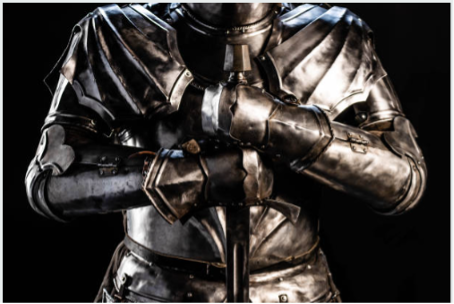
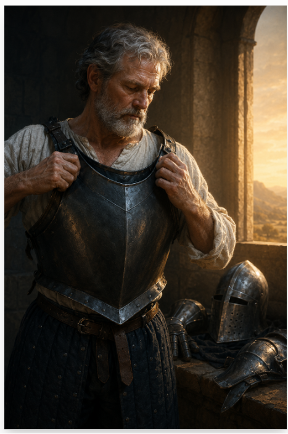
So, I equipped myself with a suit of armor—emotional, psychological, and existential. I chose the thickest breastplate. Protect the heart at all costs.
But armor does two things. It keeps people from getting in, and it keeps you from getting out.
Elders shed their armor. Some remove it piece by piece. Others leave the whole contraption behind. It has become too heavy to carry.
What allows an Elder to do that?
As an Elder, what I have discovered is that personality is useful, but it is not who they are.
Identity serves a purpose, but it is fluid, not permanent.
The ego may well be protected, but it should absolutely not run the whole show. Ego is not nearly as qualified for the job as it thinks it is. As an Elder, heart and intuition have equal time with ego, and have veto power.
Something remarkable happens when we Elders stop maintaining a personality and defending an identity: the fear of being exposed disappears. There is just so little to protect.
That is why vulnerability is not an Elder’s weakness. It is their strength.
An Elder can say “no” without regret or guilt—and “yes” only when they mean it. Each statement requires chutzpah because each risks telling the truth instead of performing.
Vulnerability does not mean sharing everything with everyone. That is not wisdom. That is simply poor judgment.
When an Elder becomes vulnerable, something changes in the room. Other people relax. People put the brakes on performing. They become more willing to tell the truth, and to confess and disclose.
Elders are not easily embarrassed when they are no longer protecting an image. They aren’t easily diminished because their worth no longer depends on approval.
They are rarely controlled by rejection because they have stopped rejecting those hidden parts of themselves.
Vulnerability is the Elder’s power.
Vulnerability is standing before life without armor—not because you cannot defend yourself, but because you no longer need to defend the person you manufactured yourself to be.
And when the armor finally falls away, what remains is not weakness.
What remains is you.
Artificial intelligence (AI) was used selectively to assist with research, due diligence, fact-checking, references, and editorial refinement. The author independently evaluated all material and takes full responsibility for the ideas, conclusions, and final content. AI was a tool—not a coauthor.
The definitive TED talk on vulnerability is “The Power of Vulnerability” by Brené Brown, which explores human connection, shame, and worthiness
Artificial intelligence (AI) was used selectively to assist with research, due diligence, fact-checking, references, and editorial refinement. The author independently evaluated all material and takes full responsibility for the ideas, conclusions, and final content. AI was a tool—not a coauthor.