

One Minute Elder
GETTING OLDER OR GETTING OLD?

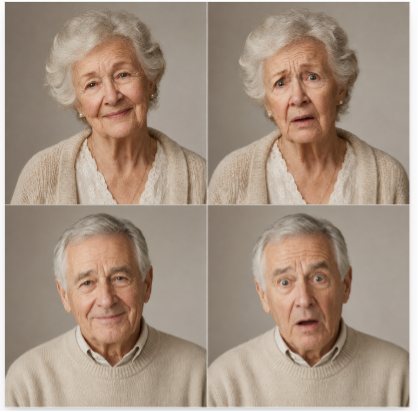
GETTING OLDER OR GETTING OLD?
There is a moment in late aging when you finally confess you’ve gotten old.
Up until that moment, you consider yourself just getting older.
“Getting” and “gotten” are quite distinct.
Those old people who dawdle in line, drive too slowly, take too long to order lunch, and seem baffled by their phones aren’t you—won’t ever be you.
Old is over there, and you’re securely over here.
But then one day, you notice.
You notice that people are offering you their seats.
Getting your rental car, someone runs out to help you put your luggage in the trunk.
When buying a ticket for the Bainbridge Ferry, they automatically give you a senior ticket.
Your new dentist looks the same age as your oldest grandchild.
You notice, but do not reveal, that stairs have become steeper, print has become smaller, restaurant lighting has become darker, and everyone on television is mumbling.
And then there is the mirror.
You look at it now, expecting to see the person you have always known to be. Instead, it’s your father—or perhaps your grandfather staring back. He looks familiar, but you’re not sure you want to share your bathroom with him.
Then comes the unavoidable, compulsory admission:
“I am not just getting older, I am old.”
That is difficult to say because, in our culture, old is not simply an age. It is a verdict.
In this culture as well as in your head, ‘old’ means diminished, slow, forgetful, dependent, obsolete, unattractive, irrelevant.
We’ve been indoctrinated that getting old means losing the qualities that made us valuable.
Productivity declines.
Authority disappears.
Bodies deteriorate.
Social value fades away.
No wonder we resist the word old. Look what it means. Better to consider what you mean by “old.” You give meaning to words. Your characterizations of ‘old’ keep ageism alive. Yep, you inherently promote ageism.
Old has become culturally abhorrent because it brings us face-to-face with what we have spent our lives avoiding: decline, dependence, separation, and death.
Old threatens the well-constructed identity that we’ve built around being competent, valuable, needed, and in control.
· Getting old says that time is running out.
· Elders ask, “What will you do with the time you have left?”
That is the essential distinction between Elder and older.
You can get old without ever becoming an Elder. Getting old happens biologically. Becoming an Elder is a conscious act.
An Elder recognizes the losses but isn’t defined by them.
For sure, the body changes. Your roles disappear. The people that you love leave. The future becomes shorter, and the past becomes longer. But something else becomes possible: freedom from having to prove yourself.
Without too much effort, you stop competing with everyone, you stop impressing strangers, you stop maintaining an outdated version of who you once were.
As an Elder, you ask different questions.
Not, “How do I stay young?”
But, “How do I become wise?”
Not, “How do I remain important?”
But, “How can I make a difference?”
Not, “How much time do I have left?”
But, “What is the time I have left, what’s it for?”
Admitting that you are old is not surrender. It is not succumbing. It is a wake-up call.
You stop running from the word “old” and reflect on what this word might make possible.
You recognize that old age is not merely a collection of losses. It can be a period of liberation, understanding, and wisdom.
Getting older is biological and gradual.
Getting old is an admission and realization.
Becoming either old or Elder is a choice.
And that choice may turn the age you once dreaded into the most honest, useful, and meaningful passage of your life.
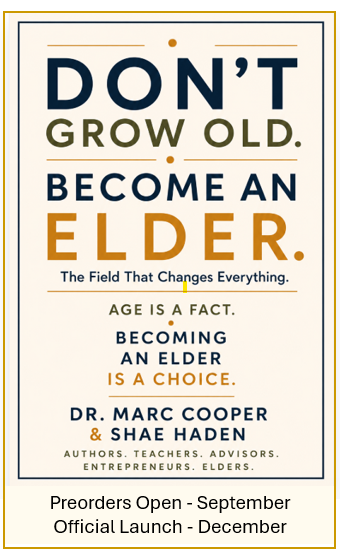
The purpose of the preorder is not simply to sell the book early—it is to build a movement of committed readers before the book officially enters the world.
Artificial intelligence (AI) was used selectively to assist with research, due diligence, fact-checking, references, and editorial refinement. The author independently evaluated all material and takes full responsibility for the ideas, conclusions, and final content. AI was a tool—not a coauthor.
Artificial intelligence (AI) was used selectively to assist with research, due diligence, fact-checking, references, and editorial refinement. The author independently evaluated all material and takes full responsibility for the ideas, conclusions, and final content. AI was a tool—not a coauthor.
Ian, I agree and appreciate everything you said. You are a demonstration of what's possible as an Elder. But what having 12 million of us, jump out of our armchairs, network together, and join our voices into one expression. Elders could and can directly influence how the future turns out. Their unified voice will carry a lot of weight.
Well put-thank you. Personally, at the age of 71 I feel more creative, uninhibited and curious than I have ever felt. If we can drop the personas that we adopt to get along in society, we are free to create authentic version of ourselves. Yes, society has a fetish about youth and would prefer that we quietly slip into a corner somewhere (maybe that old armchair) and keep our outdated opinions to ourselves. But what if we leap out of that armchair and shout "I am here and I have something to say" I believe work like yours will help that to happen.