

One Minute Elder
NEW WORDS AND THE ELDER

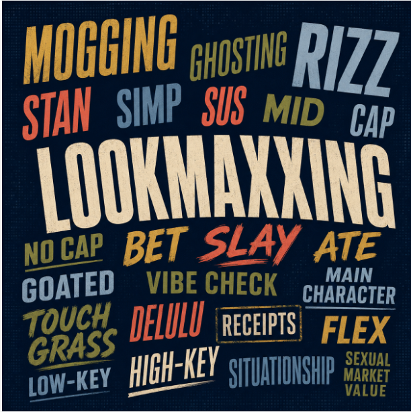
NEW WORDS AND THE ELDER
Lookmaxxers, Mogging, and Sexual Market Value
Many in my aging cohort now find words that appear alien to our individual and historical narratives. Words that didn’t exist in our vocabulary. Words that previously didn’t live in our speaking or listening.
Our personal narratives — those stories we tell ourselves about who we are — don’t know these words. Don’t understand these words. Don’t know how to use these words.
Nevertheless, in our egotism, we quickly make up a definition for them, yet we still have no idea what those words really mean.
As change accelerates, the frequency of new words will increase — especially with AI now “juicing” the speed of change.
New words, heard through the culture’s view of aging — that view of becoming obsolete, less relevant, unable to stay current — push those debilitating growing-old buttons. They reinforce the thought that you’re getting behind and will never catch up.
Simply put: new words make you feel old.
So how will Elders handle this? Not by racing to keep up. An Elder listens not only for what a word means, but for what prompted it to come into existence. Words come and go. It’s the meaning that lasts.
Lookmaxxing may be new, but the desire to appear attractive is ancient.
Mogging may sound peculiar, but competing for status has been with us since the first caveman returned with a larger woolly mammoth than his neighbor.
Sexual market value may be new terminology, but the longing to be wanted, chosen, and loved is as old as humanity.
An Elder does not need to master every new expression or pretend to be current. That performance usually ends badly. It always has for me — when I pretend I know, being fake comes right to the surface.
An Elder becomes interested instead. What does that mean? And then, more importantly, listens for what’s under the hood. Wisdom provides access to what’s underneath — the headwater. Understanding from there allows for far greater understanding, and far better solutions.
WISDOM IS ETERNAL
This is what experience teaches: new words become old words, and then they disappear. Like groovy, swell, far-out, and the bee’s knees — once fresh and fashionable, spoken with an air of importance and “hipness,” now mostly identifying the decade in which you learned to dance.
The words of wisdom, however, do not expire. Their core is eternal, not temporal.
That’s because wisdom lives in all of us. It’s innate, inborn, native. For some, unfortunately, it’s buried deep and stays unreachable in their lifetime. Others are blessed — they uncover their inner sage. They unconceal wisdom.
That’s why Elders feel incredibly lucky. The gifts of wisdom are remarkable — remarkable in their impact on how life is lived: greater equanimity, tolerance, humor, gratitude, appreciation.
ELDERS HEAR AND SPEAK WISDOM
An Elder does not fear new language or race to keep up with it. It doesn’t intimidate him or her, and it doesn’t push them over the edge into the cultural old.
An Elder listens through unfamiliar words for the familiar human being beneath them.
Words will continue to arrive, multiply, and disappear. Let them. Our responsibility is not to know every word. It is to recognize the timeless fears, hopes, and longings those words are attempting to express — and to respond with wisdom.
The world may sometimes speak a language we do not understand. But human beings are still asking the same ancient questions:
Do I matter? Do I belong? Am I loved?
Those are questions Elders are here to answer.
New language describes the changing surface of life. Wisdom recognizes what remains unchanged underneath.
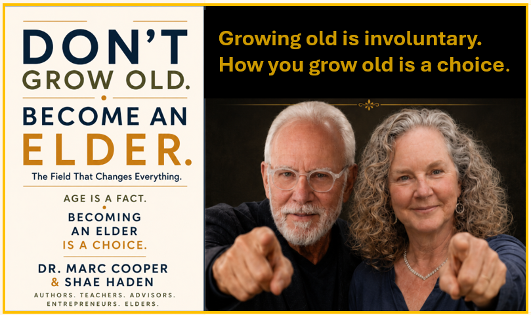
Book Launch - December 2026–January 2027
Artificial intelligence (AI) was used selectively to assist with research, due diligence, fact-checking, references, and editorial refinement. The author independently evaluated all material and takes full responsibility for the ideas, conclusions, and final content. AI was a tool—not a coauthor.