

One Minute Elder
LONELY OR ALONE

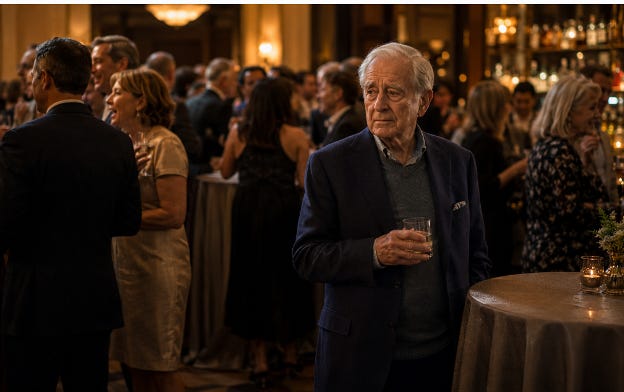
LONELY OR ALONE
By Yourself, but Never Without Yourself
As we age, we become increasingly isolated. Our heroes die. Our friends die. Our neighbors die. We move to places where we know few people, if any.
Some people are lucky enough to age in the same community. Some have spouses who are still walking alongside. But no matter if it’s later or sooner, we will all find ourselves by ourselves.
Culture deepens that isolation. It pushes the late-aged out for being too slow, too analog, too far behind the pace of a world built for speed. Like the hunter-gatherer left behind because he can’t keep up with the tribe, the aging are quietly left behind by a culture that no longer waits.
We’re perceived as providing minimal or no value. In an information-driven culture, value is measured by performance — professional performance, social performance, relationship performance. And when the performance slows, so does our perceived worth.
Look, the longer you live, the more alone you become. Unavoidable. Irreversible. Irrevocable. That’s just the way it is.
Because this is constant, Elders prepare for being alone. Without preparation, being alone directly leads to loneliness.
DISTINCTIONS FIRST
Lonely is not the same as alone. Alone means no one else is in the room. Lonely means no one seems to recognize or acknowledge that you are in the room. You are not seen. You are not heard. You are a ghost.
Elders learn how to be alone and content — at least much of the time. They’re still human, so they have the same reactions, feelings, and thoughts that arise when that sense of loneliness, of not belonging, occurs. The difference is that they know what is causing those feelings.
Like you, Elders have this experience at a party — dozens of people, multiple conversations going on, a crowded bar, every high-top full — and still feel completely alone.
Loneliness is painful. You are right in the middle of those moments when you are deemed unworthy of belonging. That hurts.
And I’m sure you’ve read the reports — now evidence-based and clinically proven — that prolonged loneliness increases stress, poor sleep, depression, cognitive decline, cardiovascular disease, weakened immunity, and earlier death. It is well known.
The cost is not only personal. Our healthcare system has done an extremely poor job accounting for loneliness’s role in the severity of chronic disease. Loneliness costs billions — in money spent managing what it worsens, and in the health outcomes it quietly erodes. Reducing it would increase healthspan, strengthen communities, stabilize families, and protect personal wealth. But even a healthcare system that woke up to this tomorrow couldn’t do the inner work for you.
So, without outside systems built to support their intentions, Elders learned to go it alone — to figure out, for themselves, how to be alone.
HOW ELDERS REDUCE THE IMPACT OF BEING ALONE
Elders have found that loneliness is not the inevitable price of aging. Aloneness can become solitude — a place for reflection, a time for creativity, an opening for spiritual connection.
Elders prepare by developing their rich inner life while continuing to reach outward. But most importantly, their focus and intention center on a meaningful connection with who they really are. That’s where the “gold” is located.
Elders focus on building a spacious inner life to live freely within and without. Building an expansive inner life is the Elder’s Super Power.
The goal is not to avoid being alone. That battle cannot be won. The goal is to become whole enough that aloneness no longer feels like abandonment.
Loneliness says, “No one sees me.”
Solitude says, “I see myself.”
Elderhood adds, “And myself as a self is the real gift.”
You may be by yourself. But you are never without yourself.
Artificial intelligence (AI) was used selectively to assist with research, due diligence, fact-checking, references, and editorial refinement. The author independently evaluated all material and takes full responsibility for the ideas, conclusions, and final content. AI was a tool—not a coauthor.
And for those of us who enjoy and desire more solitude after a busy life, there's the challenge of explaining that to others who don't understand why we'd prefer not to engage in long phone calls, party invitations and overnight visits!