

HOW DO I BECOME AN ELDER?
Part 2 of 2

HOW DO I BECOME AN ELDER?
Part 2 of 2
In Part 1, we asserted,
Becoming is not movement.
It’s an orientation.
But an orientation toward what?
That’s the question Part 1 left open — deliberately.
Because if becoming is an orientation, then what you orient to determines everything. It determines how you listen, what you notice, and how you respond when life gets complicated.
Most lives — well-lived, productive, even admirable — are still organized around the self: needs, fears, preferences, history, identity. Nothing is wrong with that. It got you here. And it isn’t going away.
But it won’t take you to Elder. Doesn’t give you access to Elder.
An Elder orients their life around four things:
1. Orient to what is required in the moment
This is situational. Fluid. Immediate.
You walk into a tense room — people arguing, posturing, defending. What’s required is not your opinion.
What is needed is stability, clarity, and equanimity.
“What can I do or say to stabilize this condition?”
Then act. Not heroically. Appropriately.
Remember, the only way people will listen is if you speak from wisdom, not good advice; from unbiased observation, not from being right. When they hear you as a wise Elder, you are one. So, figure out how to be heard as an Elder. Learn how to manage listening so your wisdom lands.
2. Orient to a higher purpose
Not a goal. Not a bucket list.
A higher purpose is what your life is now compelled to follow, given everything you’ve seen and lived.
Higher purpose is your through-line.
It answers: Why am I still here — and for what?
Once that’s clear, it becomes your reference point. Decisions align. Noise drops. You’re not pulled in ten directions because you’re not trying to be everything to everyone, including yourself.
A higher purpose decides how you decide.
A higher purpose is not something you find “out there,” because it lives in you. It’s just concealed. So, on your Elder journey, it’s about peeling back self-deception, irresponsibility, and fear, so your higher purpose can emerge.
3. Orient to the long view
Most people are trapped in short-term reactions — what just happened, what they feel, what they want resolved now.
An Elder sees patterns. Time horizons. Consequences.
They’re less interested in winning the moment and more interested in what this moment sets in motion.
That alone changes how you speak, act, and intervene.
Elders ask themselves where this conversation is headed and what the future will be if this conversation continues in this manner.
Elders manage conversations so that a future for the long-term common good results.
4. Orient to the environment you are shaping
Here’s where it gets very real.
An Elder is not just living a life—they’re shaping a field.
Every room you walk into has a tone. Reactive. Anxious. Competitive. Fragmented.
Most people adapt to it.
An Elder stabilizes it.
Without announcement. Without authority. Just by how they are — clear, grounded, not hooked.
They don’t ask, “How do I feel in this room?”
They ask, “What can happen in this room because I’m in it?”
Now, a quick reality check — with a little humor.
You won’t live here all the time.
Someone will cut you off in traffic, and your “orientation around what’s required” will briefly become some shouting and cursing, with a raised middle finger. Welcome to being human.
The orientation isn’t perfect. It’s where you return to.
So if you want something actionable, not theoretical: today, in a real situation, when you are in a conversation that has conflict, pause and ask:
What is required here?
Not for me.
Not about me.
Just: what is required?
And then — this is the part — do that.
Not perfectly. Just honestly.
That’s the orientation.
Hold that, return to that, and over time, something shifts.
You’re no longer organizing life around yourself.
You’re organizing it around what matters.
And that’s how you become an Elder.
TAKEAWAYS
Becoming an Elder is not a project.
There’s no checklist. No certification. No gold star at the end.
It’s not something you achieve or add to your identity like a merit badge.
(There is no “Certified Elder” program.)
It’s a shift that reorients your life.
From self… to what’s required.
From reaction… to responsibility.
From managing appearances… to stabilizing environments.
And here’s the part most people miss:
No one appoints you.
No one anoints you.
No one taps you on the shoulder and says, “You’re ready.”
You decide.
Not once—but repeatedly.
In real time.
In real situations.
Right where your old habits are already warming up in the bullpen.
You choose who you are going to be when life shows up the way it does.
That’s the work.
That’s the action.
That’s the practice.
So what do you actually do?
You orient yourself—over and over again—around four things:
• What is required now
• A higher purpose (not just what you feel like doing)
• The long view (determine how this will turn on downstream)
• The impact you’re having on the field around you
That’s it. Not easy—but simple.
And then—you act from there.
Not perfectly. Not once and done.
But consistently enough that something shifts.
And here’s the part that sneaks up on you:
You don’t “become” an Elder by declaring it.
You look back one day and realize—
your reactions don’t run you,
your presence steadies things,
and people leave your company a little clearer than when they arrived.
That’s then it hits you.
You didn’t achieve Elder.
You practiced your way into it.
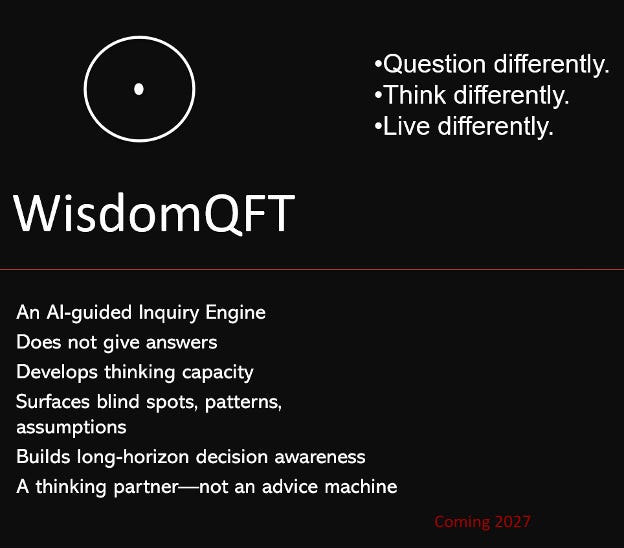
AI is accelerating intelligence.
It is not producing wisdom.
That gap is the problem.
Every system out there gives you answers.
This one does not.
It builds the capacity to think—
to see what you’re missing,
to question what you assume,
to act with range instead of reaction.
This does not compete with AI.
It counterbalances it.
Because if intelligence scales without wisdom,
we don’t get progress.
We get consequences.
Good to hear from you. Book orders.
Good Morning Mark!
If you haven't already, you may want to read "Emmanuel's Book: A Manual for Living Comfortably in the Cosmos". It has concepts that I think you will appreciate.
Highest Regards, Cheryl Townsend Winter