

A One-Minute Elder
THE AGEISM TRAP

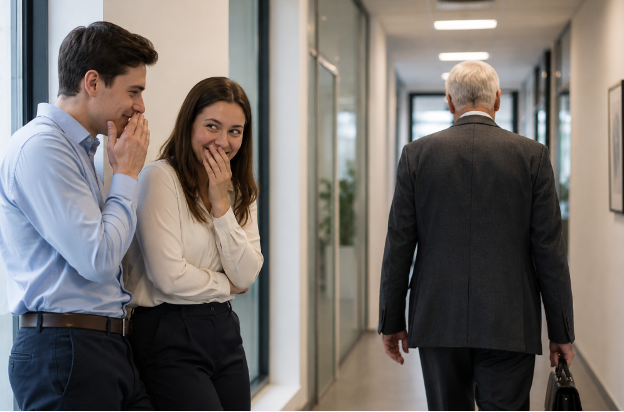
THE AGEISM TRAP
The Aging Workforce Is Exposing a Much Bigger Problem
What’s important today isn’t simply how many people are working. It’s who is working—and how old they are.
Numerous reports show America’s workforce is getting older. Financial pressure, longer life expectancy, and inadequate retirement savings are keeping people on the job longer than previous generations.
Today, nearly one-fourth of the workforce—24.5 percent—is age 55 or older. That’s the fastest-growing segment of the labor force.
But I think something else is happening that few people are talking about.
The longer older adults remain in jobs, the more ageism may actually be increasing.
Not because older workers are doing nothing wrong.
Because younger workers are trying to move up the ladder at the same time.
Titles. Promotions. Income. Influence.
Only so many seats at the table.
As the gap widens, the language changes.
It becomes us versus them.
And ageism grows.
THE REAL PROBLEM
The problem isn’t older people.
The problem is that our culture only knows how to value people through the lens of work.
Think about it.
In America, your worth is measured by productivity.
Can you still perform?
Can you still compete?
Can you still keep up?
Can you still produce?
Older adults find themselves trapped in a game that gets harder every year.
They must continually prove they are still useful.
Still employable.
Still relevant.
Still worth keeping around.
The conversation becomes:
“Can they still do the job?”
Instead of:
“What unique contribution does age make possible?”
That’s a very different question.
As more older adults remain identified primarily as workers, society becomes even more conditioned to judge them by younger standards:
Speed
Adaptability
Technological fluency
Productivity
Competitiveness
Good luck with that.
No matter how capable you are, there is always a 32-year-old who knows the software update before breakfast.
And eventually, a 22-year-old who doesn’t understand why you printed anything.
The deeper issue is that our culture never developed a meaningful role beyond worker.
It developed the employee.
It developed the retiree.
It even developed “senior citizen,” whatever that means.
But it never developed Elder.
Retirement was never a particularly satisfying answer.
Neither is endless employment.
Both models share the same assumption:
A person’s value is tied primarily to what they produce.
WHAT WE’RE MISSING
Yet many of the qualities most needed in a complex civilization emerge later in life:
Perspective
Discernment
Restraint
Pattern recognition
Long-view thinking
The ability to steady an environment rather than inflame it
Wisdom
Unfortunately, wisdom is terrible at marketing itself.
It doesn’t fit neatly into a spreadsheet.
It doesn’t show up in quarterly earnings.
It doesn’t generate exciting headlines.
And because of that, culture consistently overlooks both wisdom and the value wisdom delivers.
In a strange way, the longer older adults remain defined primarily as workers, the longer society delays the emergence of Elders.
Fortunately, that story is beginning to change.
Over the last few decades, a growing community of Elder developers, organizations, and practitioners, of which I am one, have begun knocking holes in the cultural narrative.
The castle walls are cracking.
The conversation is changing.
The question is not whether people should work at 70, 80, or even 90.
Many should.
Many want to.
Many have much to contribute.
The real question is whether work is the highest expression of late life.
My colleagues think not.
A civilization that only knows how to use its older population as labor is still trapped in ageism.
A civilization that learns how to access the wisdom of its Elders has taken a very different step.
One asks:
“Can you still produce?”
The other asks:
“What do you now see that the rest of us cannot?”
Growing old is inevitable.
Becoming an Elder is a choice.
ELDER WISDOM FULLY EXPRESSED
The 92-year-old Wanda gives you the bottom line about growing old in her short poem.
Listen closely. Watch twice. This will be you, sooner than you think.
https://www.facebook.com/reel/1094091260615347

A common question I'm asked is, ' What can I do to become an Elder?' One way is to do a retreat. It takes focused time to break the shackles of 'old age' in thoughts, beliefs, and narratives to become an Elder. One I recommend is the retreat from The Center for Conscious Eldering.
Catherine, your views align with those of many others, which is why the Elder movement is gaining ground quickly. My view is to stop playing engaging the current culture. They're saturated with ageism. They can’t hear you. At this time, it is a waste of time. Won’t be able to change the culture by arguing with it.
My strategy is to focus on your own Elderhood and on becoming an authentic Elder. The ability to be in the world more ably, more at ease, more peaceful, yet with more powerfully. The number of actual contemporary Elders is growing, and when we can collate the hundreds of Elders into one voice, it will be loud, it will be piercing, and it will be heard. But we need to develop ourselves first as Elders.
You have wisdom and very real value to contribute. But we need to be heard and recognized by the culture. And therefore, we need to be responsible for being that person worthy of being heard. And for me, that’s the work now. Increasing our self-worth, which is absolutely an outcome of becoming an Elder. You recognize and appreciate your worth. We first must believe it in ourselves. You can’t give it if you don’t have it in yourself.
The distinction between “can you still produce?” and “what do you now see that the rest of us cannot?” is one of the most important reframes I have encountered in this space, and it sits at the heart of why so many experienced professionals feel invisible precisely at the moment their judgment and perspective are most valuable. What I find in working with senior professionals is that the transition away from a purely worker identity is not a loss but a liberation — though it rarely feels that way until someone helps you see what you are actually moving towards rather than what you are leaving behind.