

A One-Minute Elder
DO ELDERS LIVE LONGER?

References Below
DO ELDERS LIVE LONGER?
Elder, as a legitimate, recognized, and participatory component of our culture, is becoming a reality. The Elder stake is firmly in the ground.
Where should the established Elder organizations invest their limited time and money to enhance Elderhood and grow their respective entities?
Most think that finding out where the greatest number of Elders and potential Elders live, then setting up “shop” there, is the smartest move.
It is not.
However, upon examination, there are no demographic hotspots for Elder or Elder candidates at this time. It’s age- and life-experience-related, not location-related.
Now, it just so happens that the greatest concentration of Elders and potential Elders tends to live in or near Blue states.
Why?
People who participate in conscious aging, personal development, contemplative practice, lifelong learning, and transformational communities are more likely to be found in urban and suburban areas, particularly along the East and West Coasts.
That’s where many of these organizations were founded and where higher educational attainment is more common. Those regions also tend to vote Democratic.
But that doesn’t mean Blue States produce more Elders.
All that means is that these organizations currently host more institutions and conversations that support Elder development.
But there is another side to this story, which is just as true.
Many of the qualities you associate with Elderhood—resilience, responsibility, stewardship, commitment to family, generosity, faith, humility, practical wisdom, and service—are abundant in rural America and in many traditionally conservative communities.
They often aren’t called “Elders.” They are called grandparents, ranchers, pastors, veterans, teachers, volunteers, or community leaders.
They have become wise as they’ve gotten older, through their life situations, and reached a way of being that provides greater equanimity with ‘what is,’ a greater tolerance of self and others, and, because of age and a more authentic relationship with their mortality, allowing their higher wisdom to flourish.
An Elder isn’t defined by whether they vote Republican or Democrat. An Elder is defined by how he or she shows up in their community, red or blue, and yes, even purple.
What Elders provide is exactly what our culture is running short of.
Perspective instead of polarization. Stewardship instead of self-interest. Discernment instead of reaction. Responsibility instead of blame. A calming presence instead of another opinion.
The opportunity before us is not to decide whether Red States or Blue States produce more Elders. It is to recognize and develop the millions of potential Elders already living in both.
They may speak different political languages, worship differently, and see the world through different lenses, but the qualities of an Elder transcend ideology. Different routes, different climbing gear, same summit.
The question, then, isn’t Where do Elders live?
The better question is, How do we find them? How do we invite them? How do we develop them?
The next generation of Elders is already among us—in every state, every town, every neighborhood, every political party, every faith, and every culture.
They are waiting, not for permission to grow older, but for an invitation to become an Elder.
That is our work.
Not to build a movement for one side of America, but for all of America. Not to deepen our differences, but to cultivate the wisdom to transcend them.
The future will not be determined by whether we have enough experts, influencers, or politicians.
It will be determined by whether we have enough Elders.
Because in the end, wisdom has no zip code. It has a way of being.
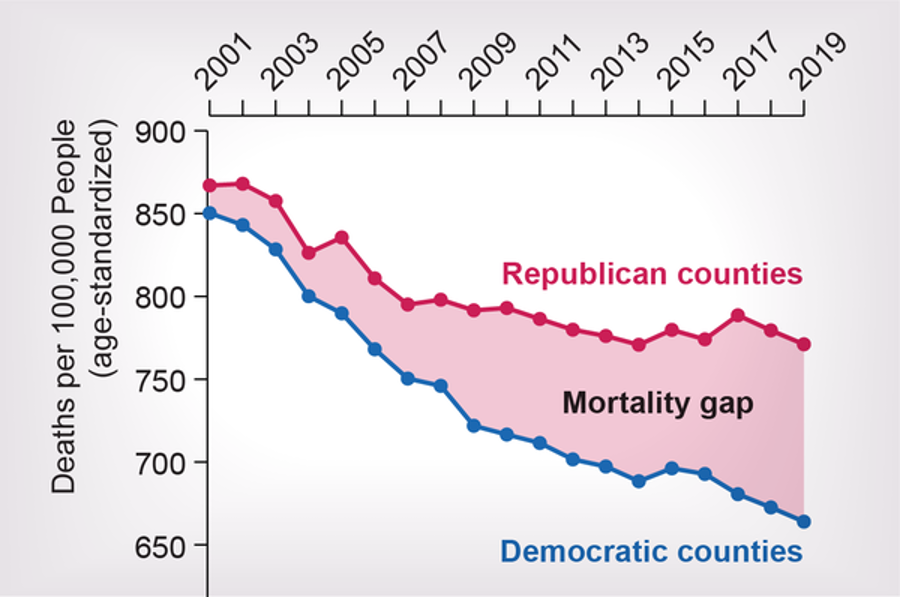
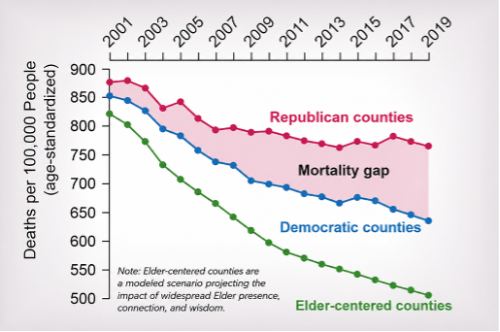
A note on the graph below: the underlying study found mortality rates declining significantly faster in Democratic-voting counties than Republican-voting ones between 2001 and 2019 — the source of my (only half-joking) prediction market wager on Elder longevity. If you’re one of the Longevity readers in my audience, this is precisely why healthspan and lifespan both favor becoming an Elder.
Reference: Warraich, H. J., et al. (2022). Political environment and mortality rates in the United States, 2001–19: a population-based cross-sectional analysis. BMJ, 377, e069308.
Thank you Marc. I always appreciate your work and energy to bring wisdom to our world rather than just opinion.