

A One Minute Elder
THE TEMPORALITY OF AN ELDER

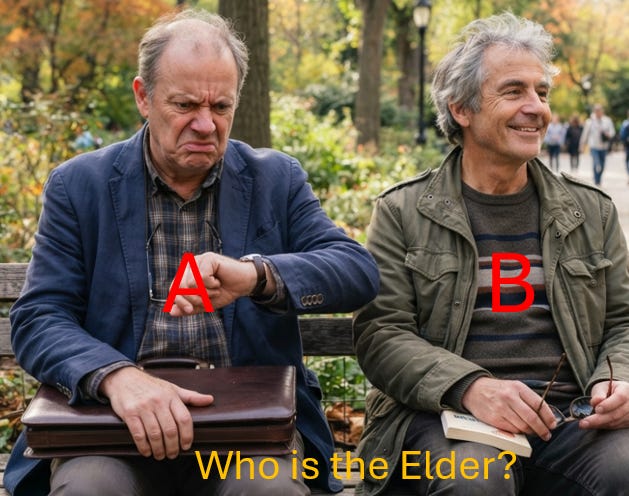
IT’S ELDER TIME
The Temporality of an Elder
Time changes when you become an Elder.
Not the clock. You.
One second is still one second. The Earth still circles the sun in 365 days. Your birthday keeps showing up whether you like it or not.
But the experience of time changes dramatically.
This may be one of the least understood distinctions between simply growing older and becoming an Elder.
Older people most often live inside shrinking time.
Every birthday becomes a subtraction problem.
“I don’t have as much time left.”
“I wish I had done...”
“If only...”
“Maybe someday...”
The past becomes heavier. The future becomes shorter. The present almost disappears between regret and anticipation.
The second hand becomes the ruler of life.
Tick.
Tock.
Tick.
Tock.
It begins sounding suspiciously like a countdown.
An Elder lives differently.
An Elder can actually expand time.
Not by adding years to life, but by adding life to years.
A single conversation can feel timeless. Sitting quietly watching the sun disappear behind the ocean can seem to last forever. Playing with a puppy somehow suspends the clock altogether.
Nothing magical happened.
Presence happened.
The Stoic philosopher Seneca wrote, “It is not that we have a short time to live, but that we waste much of it.”
He wasn’t talking about productivity.
He was talking about inhabiting life.
Elders come to realize this.
The older I become, the less interested I am in hurrying toward tomorrow.
After all, I’ve finally arrived at today.
That may be one of aging’s greatest gifts. It certainly is for me.
Eckhart Tolle observed, “When your attention moves into the Now, there is an alertness... as if you are waking from the dream of thought.”
Exactly.
Older often lives in psychological time.
Elder lives in existential time.
There is a difference.
Psychological time is filled with stories.
“I should have...”
“What if...”
“I hope...”
“I’m afraid...”
Existential time asks only one question:
What is here now?
That question changes everything.
An Elder can sit with grief without rushing it away.
Enjoy joy without trying to possess it.
Listen without mentally preparing a reply.
Walk without needing to arrive.
Love without keeping score.
Forgive, not succumb or surrender.
The clock is still ticking, but it no longer dictates reality.
There are moments when an Elder steps completely outside of time.
You have probably experienced them.
Maybe listening to Miles Davis’ Kind of Blue or Weather Report’s Heavy Weather.
Holding the hand of someone you love as they take their final breath.
No one checks their watch.
Because in those moments, there is no before or after.
There is only Being.
Tolle writes, “The present moment is all you ever have.”
I’d add that the present moment is where the Elder focuses on living.
It’s a back-and-forth between terminology, but the frequency is so much higher and getting stronger on being here now for Elders.
That is why Elders seem calmer.
Why they are less reactive.
Why people often leave their presence feeling they somehow have more time than when they arrived.
The Elder doesn’t merely manage time.
The Elder changes the experience of time itself.
Perhaps that is one of the greatest contributions an Elder makes to a frantic culture obsessed with speed.
The world doesn’t need more people racing against the clock.
It needs more people who remind us that beneath every ticking second lies something timeless.
That place is where wisdom lives.
And that place is called Elder.
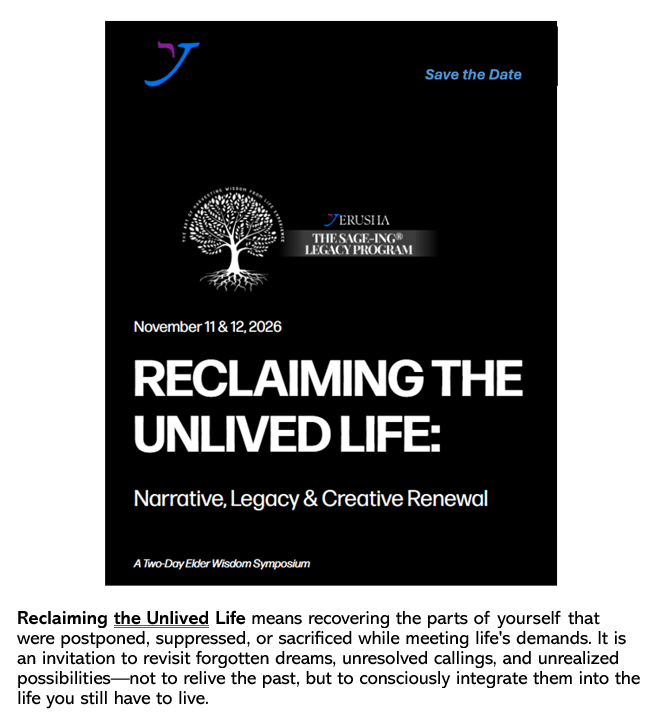
For more information visit: https://www.yerusha.org/slp-symposium2026
Thank you for this!