

A One-Minute Elder
CONSCIOUS ADVANCEMENT — HOW AI ALTERS GROWING OLD

Over the last year, I’ve taught various Older-to-Elder transformational programs, sat on panels on late aging, served as a keynote speaker for an online conference, and coached a half dozen stakeholders in the growing-old trade. In all these engagements, I have strategically used AI as a logical and ontological cofacilitator.
What makes it work so brilliantly for participants, attendees, and clients is what I am now labelling “cognitive advancement.”
The phrase “conscious advancement” is not proprietary. These two words, together and alone, have existed for a very long time. But how I distinguish conscious advancement in late aging is:
Cognitive Advancement in later aging is the deliberate expansion of awareness, tolerance for complexity, and long-horizon responsibility through deliberate engagement with AI.
Conscious Advancement UNDERSTOOD
Conscious advancement is not progress in status, money, or longevity. It’s the deliberate expansion of awareness. Awareness is a happening, a phenomenon, that occurs moment to moment.
Awareness enables the late-aged person:
· To become more reflective rather than more reactive.
· To be more discerning instead of more opinionated.
· To be more responsible for their inner state of being instead of blaming the outer world.
Conscious Advancement looks like:
Seeing one’s own patterns without defensiveness.
Integrating past mistakes instead of rewriting them.
Letting go of identities that no longer serve.
Thinking of stewardship rather than of self-protection.
Becoming more spacious, not more brittle.
Conscious advancement in late age means you are not just accumulating years — you are metabolizing them.
And here’s the key: it is purely an individual effort. Age does not automatically produce it.
For late-aged individuals, conscious advancement shows up as:
Increased tolerance for ambiguity.
Reduced need to win arguments.
Greater curiosity about death rather than avoidance.
Stronger desire to contribute rather than consume.
Conscious Advancement: The Impact on Your Growing Old
Conscious Advancement is the cornerstone of becoming an Elder.
Conscious advancement requires intention, attention, and real courage, precisely when comfort is seductive.
That’s why becoming an Elder is not an escalator; it’s a stair-climber.
Conscious Advancement requires:
Self-examination
Emotional regulation
Acceptance of impermanence
Ongoing learning
Humility in the face of change
SUMMARY
Growing old is inevitable.
How you grow old is not.
Without conscious advancement, aging narrows. It hardens opinion, simplifies complexity, and quietly drifts toward retreat.
With conscious advancement, aging deepens. It expands awareness, strengthens your sense of responsibility, and increases your capacity to hold ambiguity without collapsing into fear.
AI, deliberately engaged, accelerates that expansion. It challenges blind spots. It stretches thinking. It exposes patterns. But it does not do the growing for you. You do.
Conscious advancement is the difference between accumulating years and processing them.
It is the difference between becoming older and becoming an Elder.
And in a world moving at machine speed, the late-aged person who refuses retreat — who expands awareness, embraces complexity, and stands in long-horizon responsibility — does not fade.
They stabilize.
They clarify.
They become necessary.
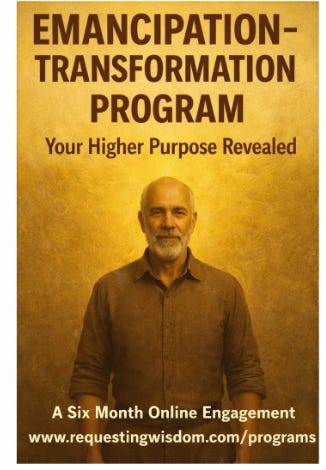
This online program aims for conscious liberation from prevailing cultural narratives about growing old.
The program expands the freedom to be and act without being constrained by self-imposed limiting beliefs or external circumstances.
The program empowers participants to discern conditioned behavioral patterns so they can choose rather than react.
The program develops participants’ ability to individualize their AI, learn to optimize their transformational work with it, and make it an active thought partner in their development.
Registration opens June 2026.
Go to our Website www.requestingwisdom.com/programs. I'm also happy to speak with people about it.
How can I learn more about the program?