A One Minute Elder
WHAT'S IT MEAN TO BE AN ELDER?

WHAT TO TELL YOUR FRIENDS WHEN THEY ASK: WHAT’S IT MEAN TO BE AN ELDER?
This is the question.
The most frequently asked question.
The foundational question.
The one question upon which everything else rests.
People don’t have to wonder what it means to grow older. They’re doing it.
They see it in the mirror every morning. They feel it every time they stand up a little too quickly. They have conversations about it—with themselves, with friends, with doctors, with their financial advisor, and occasionally with their knees.
Growing older isn’t an idea. It’s an experience.
They live inside a cultural “field” saturated with stories about aging. A field that quietly—and relentlessly—tells them that growing older means decline, irrelevance, limitation, dependency, and eventually becoming yesterday’s news.
Not exactly a Hallmark card.
Those stories become so familiar that they disappear into the background. They become the context through which people interpret every gray hair, every birthday, every forgotten name, every new ache, every retirement decision, and every glance in the mirror.
Most people never question the narrative because it seems like reality.
But it isn’t reality.
It’s a story.
A story repeated often enough that it becomes “the truth.”
The distinction between growing older and becoming an Elder begins right there. Recognizing it’s a story you’re living into.
An Elder is not simply an older person with more birthdays.
An Elder inhabits an entirely different field.
A different context.
A different way of seeing life.
A different relationship with time.
A different relationship with themselves.
A different relationship with everyone around them.
That is why the question, What does it mean to be an Elder?, is so important.
It is not asking for another definition of aging. It is asking whether there is another possibility altogether.
Is there another way to live the last third of life?
Most people have never been asked. I believe there is.
In fact, I believe becoming an Elder is one of the greater developmental possibilities available to a human being.
It isn’t automatic.
Age doesn’t confer Elderhood any more than owning a piano makes you a piano player.
Birth certificates tell you how long you’ve been alive. They tell you absolutely nothing about who you’ve become, and certainly not who you will be.
An Elder isn’t defined by wrinkles, retirement, wisdom quotes on Facebook, or an impressive collection of prescription bottles.
An Elder is defined by presence.
By consciousness.
By responsibility.
By the capacity to stabilize the human environments they enter.
By becoming someone whose very way of being leaves people, relationships, families, organizations, and communities better than they found them.
That is why this Substack exists.
Not to help you grow older.
You’re already doing that remarkably well.
Its purpose is to invite you into a possibility that our culture has largely forgotten.
To become an Elder.
Because growing old is inevitable.
Becoming an Elder is a conscious choice that requires attention and intention, but its rewards extend far beyond your biological life.
It changes how you experience yourself, how others experience you, and the impact you have on every environment you enter.
It doesn’t simply add years to your life. It adds life to your years—and perhaps, in the process, leaves the world a little wiser than you found it.
The work of an Elder is not just self-development; it is improving the human environments they enter.
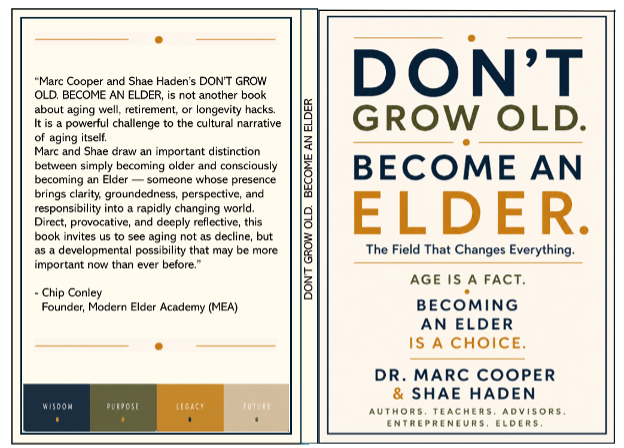
P.S. — the book is coming December ‘26–January ‘27. Stay tuned for more info.