

A One-Minute Elder
Why “Older” People Are Afraid of AI And Why They Shouldn’t Be


Why “Older” People Are Afraid of AI
And Why They Shouldn’t Be
Let’s be honest.
Most “older” people are not afraid of artificial intelligence.
They’re afraid of humiliation.
They’re afraid of looking foolish. Of pushing the wrong button. Of exposing that the world moved on while they were busy raising families, building companies, surviving recessions, burying parents, and paying taxes.
AI feels like one more reminder that the future is no longer being written in their handwriting.
There’s also a deeper fear.
‘If intelligence can be simulated, what happens to the value of my intelligence? If a machine can answer faster, calculate better, and retrieve more information faster and richer than I can, what exactly is left of me?”
For a generation raised to equate worth with knowledge, it’s unsettling.
But here’s the punchline.
AI does not compete for wisdom.
AI competes for information.
Information was once a highly valued asset. Then Google and Wikipedia came along. The asset value quickly diminished. Now AI is here, disintermediating Google and Wikipedia.
Information, once an exclusive asset, is now available at nominal cost. Any time, anywhere, at your convenience. Now, what’s information worth?
On the other hand, wisdom is, was, and will always be valuable. In fact, its value is increasing. Like gold, its value rises when uncertainty, instability, and threat appear.
Why They Should Be Interested
The benefit for older adults is not becoming “tech savvy.” That’s a shallow goal. The real benefit is amplification - expansion, augmentation, and development of their wisdom.
AI will organize thoughts. It will summarize research. It will generate questions that provoke reflection. It will help articulate what you’ve known but never quite put into language. It will incite insights.
AI will not replace your thinking; it will refocus, redirect, and sharpen it.
AI doesn’t just help you complete tasks. It helps you examine the assumptions, values, and patterns underneath the tasks. It becomes less a tool of productivity and more a mirror of who you are while you’re producing.
AI is not only a functional assistant. It will be a reflective partner — one that helps you see how you think, not just what you think.
AI won’t just increase output. It will increase awareness.
AI will become a sparring partner. A second set of eyes. A pattern detector. A bias interrupter. It will ask, “Have you considered this?” It will challenge blind spots without ego. It will work at 2 a.m. without resentment.
For someone in their 60s, 70s, or 80s, that’s not trivial; it’s about a cognitive extension.
Why They Shouldn’t Be Afraid
Now let’s talk about cost.
The cost of avoiding AI is not moral superiority. It is gradual irrelevance.
The workplace is integrating it. Healthcare systems are using it. Financial institutions are deploying it. Governments are shaping policy around it.
If you refuse to engage, you don’t stop the train. You just remove yourself from the steering committee.
There is also a personal cost.
Without AI, many older adults shrink their intellectual world. They consume more than they create. They read headlines rather than explore nuance. They default to opinion instead of inquiry.
AI can reverse that trend.
Older adults who adopt AI will become adaptive rather than defensive. Curious rather than resistant. Engaged rather than sidelined.
The fear says, “This will replace me.”
The truth is simpler.
Yes, AI does replace routine cognition to some degree, but it can’t -
· Replace judgment.
· Replace presence.
· Replace lived experience.
You need all three to be wise. Therefore, AI will never be wise because it doesn’t possess, nor can it possess, these qualities.
And this difference might determine whether the last decades of your life are spent shrinking or expanding.
Your move.
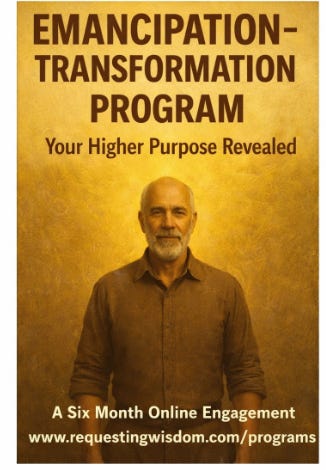
This online program aims for conscious liberation from prevailing cultural narratives about growing old.
The program expands the freedom to be and act without being constrained by self-imposed limiting beliefs or external circumstances.
The program empowers participants to discern conditioned behavioral patterns so they can choose rather than react.
The program develops participants’ ability to individualize their AI, learn to optimize their transformational work with it, and make it an active thought partner in their development.
Registration opens June 2026.
I agree with everything you say. AI saves me time and money. Used well, it's a wonderful personal assistant.
I'm not afraid of AI I just don't like it. I'm an elder and a Luddite.