

A One-Minute Elder
ELDERS KNOW HOW TO BE COMPLETE

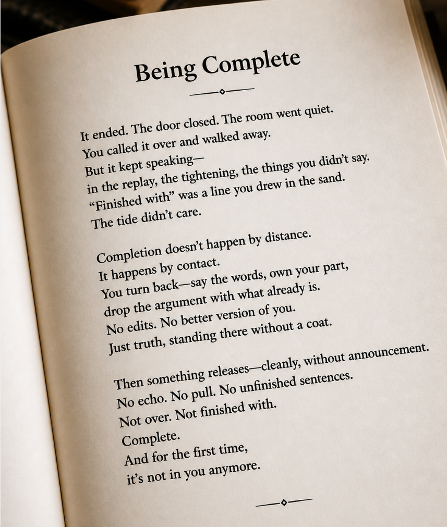
[From Marc’s unfinished Poems of a Contemporary Elder]
ELDERS KNOW HOW TO BE COMPLETE
In the Elder vocabulary, complete does not mean over or finished with.
Complete doesn’t mean “the end.” It doesn’t come with a curtain drop and then applause.
It doesn’t mean you stop thinking about it just because time has passed.
Look at your life. Relationships end. Jobs end. Conversations end. People die.
“It’s over.”
And yet… the residue lingers. The replay runs on. The commentary continues.
You remember—that heartbreak didn’t end when it ended. It kept going, long past the final dramatic scene. And even after years, there are those times when those flurries of vicious thoughts, deep anger, the buried resentment, the sharp bitterness, erupt. It isn’t over; simply subdued, still there, persisting.
It may be over, it may be finished with, but it is certainly not complete.
To be complete is to be whole, resolved, nothing left open.
Nothing pending. Nothing unsaid. Nothing still quietly running in the background. The emotional charge and physical reactions are gone.
Now, contrast that with ‘over’ and ‘finished with’.
Over is temporal. It ended. That’s it.
You shout into a canyon. The sound stops—it’s over.
But the echo keeps coming back.
That’s the part most people live in.
That’s why they call it an “echo chamber.”
You leave a room, close the door—over.
But you left something unsaid inside.
Now you’re standing outside the door… still in the conversation.
You left the room, but the room didn’t leave you.
The could-haves, the should-haves, the self-incrimination, the blame, the remorse continue to creep in.
Finished with is behavioral.
It has a tone— “I’m done.” Sometimes with a little attitude, sometimes with a shrug.
But walking away is not the same as being complete.
Something can be over and still run you.
Something can be finished and still own space in you.
Only when it’s complete does it release its grip.
Now, the how.
Elders don’t get complete by waiting. Or hoping. Or “processing it over time.”
That’s avoidance with a wellness vocabulary.
Completion is existential. Existential refers to anything that has to do with existence itself—being alive, being human, and the fundamental conditions of life like meaning, freedom, choice, and death.
It points to the questions you can’t outsource: why you’re here, how you live, and what your life stands for.
“Over” and “finished with” are surface-level—they deal with time and behavior. Something ended, or you walked away. That’s administrative. Life keeps moving, but the thing may still be sitting inside you, unresolved.
Completion is existential because it alters your state of being. It’s not about the event ending, it’s about whether it still exists in you as unfinished business.
When something is complete, it no longer defines your mood, your reactions, your future. It has no more say. It has no more sway.
“Over” happens in time.
“Finished” happens in behavior.
“Complete” happens in being.
HOW ELDERS GET COMPLETE
First, they tell the truth. Not the edited version. Not the version that keeps them looking good. The actual truth, what happened, what they did, what they didn’t do, what it cost. Until the truth is clean, completion is not obtainable.
Second, Elders take responsibility. Not blame—responsibility.
Blame asks, Who screwed this up? Who screwed me?
Responsibility asks, What is mine here? What’s required now?
And then they take that on. No negotiation.
Third, they clean up what’s left open.
Conversations not had. Apologies not made. Gratitude not expressed. Decisions not declared.
If there’s a call to make, you make it. If there’s something to say, you say it.
Not someday. Today. “Someday” is where completion goes to die.
Fourth, Elders drop the argument with the past.
This is where most people get stuck. They want completion—but only if what happened didn’t happen.
That’s not completion. That’s fantasy.
An Elder lets what happened be what happened. No appeal. No retrial.
And finally, they declare it complete.
Not casually. Not as a bypass. But as a conscious act when the work is done.
Completion is a stand you take.
And just to keep it human: most people don’t need ten more years of analysis.
They need a phone… and a spine.
Completion isn’t mystical. It’s disciplined.
And when something is truly complete, it no longer takes up real estate in your life.
Play it loud and dance: When you’re complete, “you’re already gone.”
Living at this time on earth, in our country, at our age, now with our greater authenticity, empathy, and deeper concern for not just our future but the future itself, it's difficult to be complete, especially when the it, he, she, or they doesn't go away physically.
Everyday. Headlines. Talk in the hallway, at the bar. On every screen. All the time. You can feel the resentment in yourself and see it on the faces of people everywhere. You're upset you have to live your life in these waters. And you are taking action, writing, speaking, protesting, praying, meditating, but it keeps returning.
You, me, everyone is feeling it. What I recommend you focus on is not the exterior. It will do what it does. And not to get indifferent about it. No, I am suggesting work on what remains incomplete in your life, living or dead. And identify what you need to do, say, and act to get complete. And do that. A way better use of your time, and more importantly, when you leave the planet, you'll be way lighter.
What a ‘complete’ experience reading this and knowing the truth of it through the practice of it and when I don’t! Thanks Mark. Oh…What a great song to encapsulate the message! Rock on!